Strategy and risk

Why investors can lose money in a profitable strategy

19 February 2026 · By Evgenii Voronchikhin

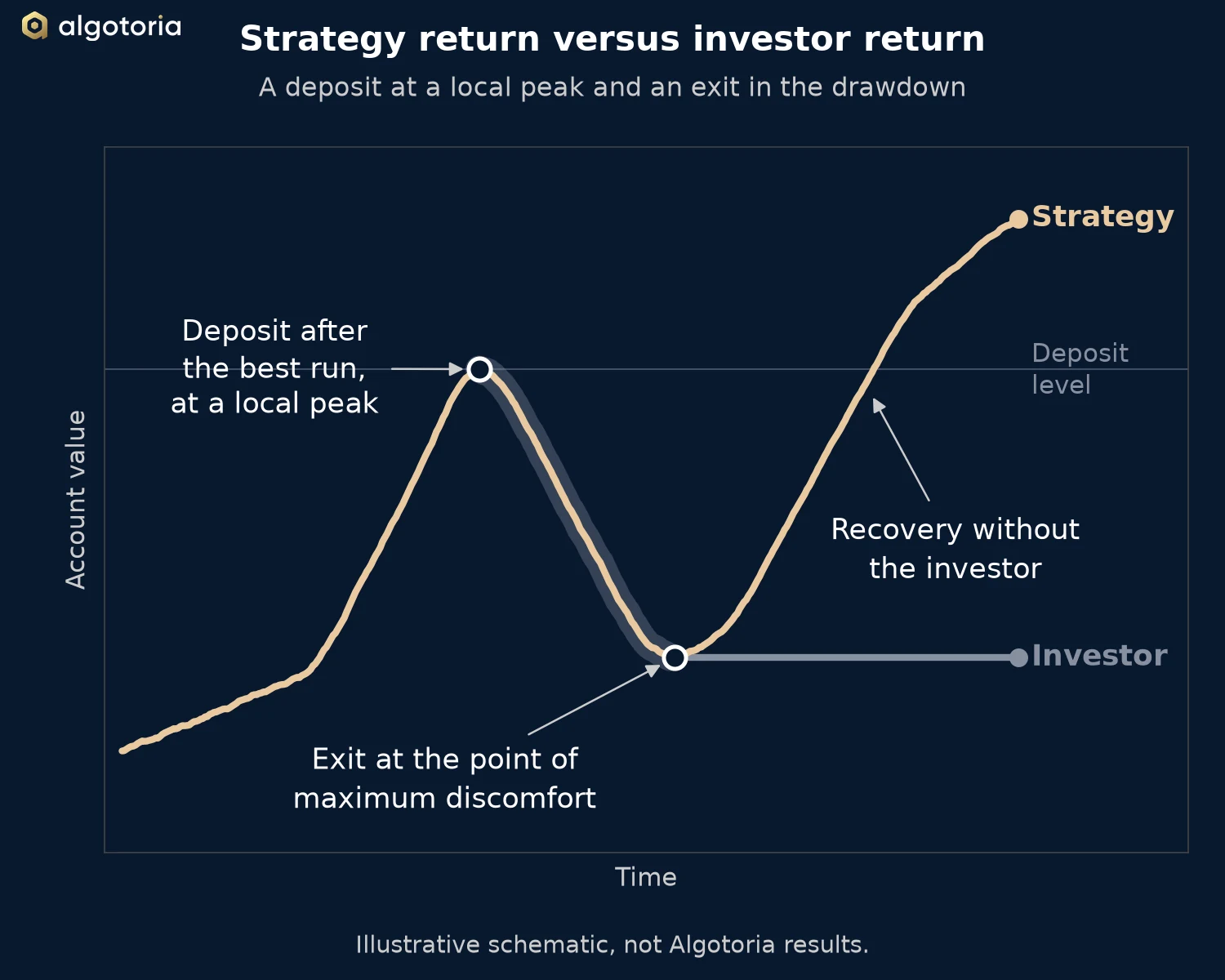
Schematic of a strategy equity curve that recovers to new highs, while an investor who deposited at a local peak and exited at the bottom of the drawdown stays below the deposit level.
Illustrative schematic of investor timing, not Algotoria results.

A strategy can be statistically profitable, with positive mathematical expectancy, an adequate Sharpe ratio and controlled drawdowns, and an investor in it can still lose money. The cause is usually not the algorithm. It is the timing and the behaviour of the investor.

The strategy’s own return and the return an investor actually earns are two different numbers. The first is measured over the whole period. The second depends on the day the money arrived, the day it left and what happened in between. This article sets out the six mistakes that most often separate the two.

1. A horizon shorter than the strategy’s cycle

Algorithmic strategies, trend-following and multi-system ones in particular, earn their return over a long period. They also have stretches of stagnation, sideways markets and drawdowns, and these are a normal part of the process.

An investor who arrives with a horizon of three to six months and expects a steady, linear return will be disappointed when the market enters an unfavourable phase. Algotoria publishes a minimum investment horizon of one year, so that the strategy can pass through a full range of market conditions. A horizon shorter than the strategy’s statistical cycle judges a long-run process on a short sample.

2. Entering after the best run

The classic mistake is to invest after seeing a strong equity curve. A strategy has an excellent year, attention builds, money arrives at a local peak, a natural correction or drawdown follows, and the investor sees a loss within weeks of entering.

The pattern is a behavioural one: past returns are extrapolated into the future, although markets move in cycles. The investor in effect buys the strategy at its peak price.

3. Leaving during a drawdown

Drawdowns are part of any systematic trading. Psychology works against the investor here: greed on the way up, fear on the way down.

An investor who leaves at the point of maximum discomfort locks in the loss at the moment when the expectancy of the strategy begins to improve. The strategy then recovers without that investor. The Risk Disclosure Notice sets out the drawdowns that Algotoria’s strategies can produce.

4. Switching between strategies

Another common pattern is repeated switching. Strategy A is in a drawdown, so the investor moves to Strategy B, which has just done well. A few months later the cycle repeats.

The result is a systematic sale of the drawdown and purchase of the past performance. Over several cycles this is an effective way to erode capital, because every switch crystallises a loss and restarts the clock.

5. Misreading the risk and return profile

Many investors look only at the average return. The profile also includes the depth and duration of drawdowns, volatility, the frequency of negative months and the correlation with the wider market.

A strategy can have positive expectancy and an uneven return profile at the same time. An investor who is not prepared for that equity curve will find it hard to stay invested through it.

6. No plan and no rules

A professional approach needs four things in place before the first deposit: a predefined horizon, a clear understanding of the acceptable drawdown, fixed rules for adding and withdrawing capital, and diversification across strategies.

Without them, an account under professional management turns into emotional trading carried out through an intermediary. The frequently asked questions explain how the drawdown budget works and what redemption involves, which are the two parameters a plan should fix first.

The conclusion

In algorithmic strategies, the part that fails is more often the investor’s behaviour than the model. A strategy asks for time, discipline, patience and an understanding of the statistics behind it.

If the investor cannot hold through the normal phases of the market, even a profitable algorithm will not protect the capital. Behavioural resilience is therefore part of the long-run result, alongside the code.

Get Started

Typical onboarding takes one business day, plus the international bank transfer if you fund from fiat.

Start a conversation

Tell us a little about yourself and a co-founder will reply within one business day.

By submitting, you agree we may contact you at the details above. We do not share your data with third parties. For qualified investors only. We keep enquiry details for 12 months if they do not lead to a relationship. See our Privacy Notice at algotoria.com/privacy.

How is performance measured? Why does my exchange dashboard show a different number?

Daily time-weighted returns (TWR) with compounding, computed from the unrealised margin balance of each strategy's reference portfolio, denominated in USDT and rebased to 0.00% on 1 January 2024 for the public chart. TWR is the industry-standard methodology that eliminates the distortive effect of capital movements (deposits and withdrawals) on the percentage return. Exchange dashboards (OKX, Binance, Bybit) use simplified estimation methods that do not properly handle transfers, so their headline percentage will differ. The absolute dollar-denominated P&L on the exchange dashboard remains correct; only the percentage is affected.

What drawdowns should I realistically expect?

Typical annual drawdowns of 20–25% on Algotoria Classic Stable, 15–30% on Algotoria Classic Diversified. Historical back-tests reached 30%. Drawdowns beyond these ranges trigger a formal Investment Committee review.

All drawdown figures quoted on this site — and the agreed drawdown budget selected during onboarding — are measured on the gross trading-account return curve, before deduction of Algotoria's quarterly performance fee. Net-of-fee drawdowns experienced by the investor are larger by construction. Worked example: for Algotoria Classic Stable over 2024-01-01 → 2026-09-30, the adjusted maximum drawdown is −24.7% gross, −30.2% net of a 25% fee, and −31.3% net of a 30% fee.

What is the "drawdown budget" (formerly "account risk"), and how is it enforced?

The drawdown budget is the target maximum gross drawdown of the account from its most recent high-water mark — the headline number selected during onboarding (10% / 20% / 30% for Classic Stable; 15% / 25% / 35% for Classic Diversified). No drawdown-triggered de-risking is implemented in the trading software and none is applied by default. Drawdown is alerted in real time at 60%, 80% and 100% of the budget; at two-thirds of the budget the Investment Committee reviews the account and decides case by case whether to reduce risk, and at the full budget you are notified and choose whether to continue, reduce the budget or stop trading. The automatic layer is volatility-scaled position sizing and the stop-losses attached to every trade — nothing else de-risks an account on its own. An automated hard stop at a level you specify can be agreed as a custom policy for your account at onboarding. It is an engineered envelope, not a guarantee — the Risk Disclosure Notice publishes the estimated probability of exceeding it. The investor may change the tier at any quarter-end.

How does redemption work?

Five business days' notice is required. Partial redemptions are supported. If a redemption falls mid-quarter, a pro-rata performance fee is calculated for the period during which Algotoria actively managed the account, using the same rolling HWM methodology. During severe market stress with large simultaneous withdrawals, the algorithm is programmed to prioritise the liquidation of the most liquid instruments and to scale down portfolio leverage so the outflow is absorbed without generating outsized slippage.

See the full due-diligence FAQ for 50+ additional questions.
Algotoria Limited is a BVI-regulated Approved Investment Manager under the Securities and Investment Business Act, 2010. The content on this page is informational and does not constitute an offer to sell securities or investment advice. Services are available to qualified investors only. Past performance is not indicative of future results.