Strategy and risk

New trade filters for Bitcoin, Ethereum and Solana

30 January 2026

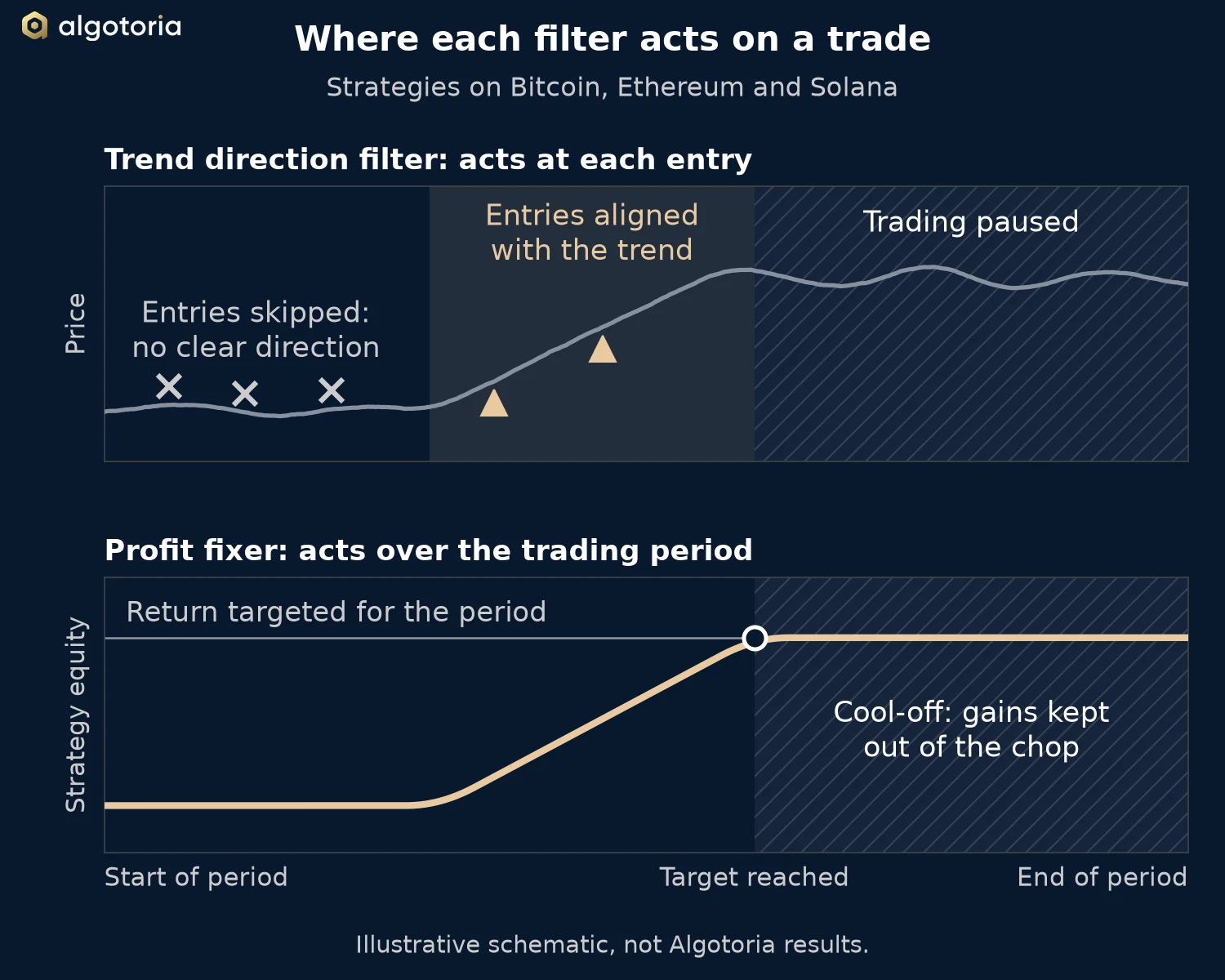
Schematic of one trading period: entries are skipped without a clear trend and taken in line with it, and trading pauses once the return targeted for the period is reached.
Illustrative schematic of where each filter acts, not Algotoria results.

Algotoria has made two updates to the strategies that trade Bitcoin, Ethereum and Solana. Their purpose is to raise the quality of entries and to remove the noise that sideways markets create for trend-following systems.

Why sideways markets need a specific answer

Trend-following strategies earn most of their return in sustained directional moves. In a market that reverses direction often, with moves too small to carry a trend, the same systems enter and exit repeatedly and each trade costs a little. The result is a series of small losses that wears down accumulated gains.

This is the environment in which the strategies are weakest, and the frequently asked questions say so plainly. The two filters address it at the level of the individual trade, so that the systems remain rule-based and do not depend on a forecast of when the market will move.

The trend direction filter

Under the trend direction filter, a position is taken only when it is aligned with an independent trend signal. When the market has no clear direction, the systems stop trading against it.

The effect is a smaller number of entries, with each one backed by a stronger directional signal. Fewer low-probability setups also means fewer of the round trips that erode capital in a flat market.

The profit fixer

The profit fixer is a dynamic cool-off rule. Once the return targeted for a defined period has been reached, trading pauses.

The aim is to prevent give-back. Gains made early in a period are not exposed to the choppy conditions that often follow a strong move.

What the filters trade off

Limiting activity in flat markets produces a smoother equity curve and smaller losses in sideways phases. The cost is some upside: a filter that skips low-probability setups will sometimes skip a trade that would have worked, and a cool-off can pause trading ahead of a move that would have added to the gain.

Algotoria accepts a marginal loss of upside in return for stability in the unfavourable phase. The filters reduce the weakness of trend-following in flat markets. They do not remove it, and the strategies can still draw down. The Risk Disclosure Notice describes the risks in full.

Get Started

Typical onboarding takes one business day, plus the international bank transfer if you fund from fiat.

Start a conversation

Tell us a little about yourself and a co-founder will reply within one business day.

By submitting, you agree we may contact you at the details above. We do not share your data with third parties. For qualified investors only. We keep enquiry details for 12 months if they do not lead to a relationship. See our Privacy Notice at algotoria.com/privacy.

When does the strategy excel, and where does it struggle?

It thrives in trending and trending-volatile regimes — sustained moves in either direction, with enough volatility for the entry and exit logic to capture range. It struggles in extended low-volatility regimes where signals do not develop, and in chop where directional moves reverse before take-profits trigger. The counter-trend and volatility-filter sub-strategies were added specifically to dampen performance in those conditions. Concrete evidence: during January–February 2026, Bitcoin fell roughly 24% while Algotoria Classic Stable returned approximately +49% gross and Classic Diversified approximately +28% gross — directional short-side moves are favourable conditions, not catastrophic ones.

How is alpha decay managed? How are strategies added and retired?

Every sub-strategy undergoes quarterly review against live-versus-research drift and rolling information-ratio thresholds. Decaying strategies are de-weighted and ultimately retired. New candidates enter through a six-stage validation pipeline: in-sample → out-of-sample → cross-validation → paper-traded incubation → live incubation with size cap → full production. Strategies whose risk-reward collapses in a market shock — cross-exchange arbitrage and similar latency-dependent constructs are the canonical example — are structurally excluded regardless of back-tested Sharpe.

How many sub-strategies run in the book, and what families do they cover?

Currently 21 as of 30 September 2026, from a set of 10–50 uncorrelated systems approved by the Investment Committee and adjusted to market conditions. They span trend-following, counter-trend, mean reversion, momentum and volatility families, applied across four timeframes (5 minutes, 15 minutes, 1 hour, 4 hours). Capital is allocated on a risk-parity basis so each sub-strategy contributes a similar share of risk rather than being weighted by expected return. The overall capital split was 66% trend-following and 34% counter-trend as at 31 August 2026 — the counter-trend allocation compensates during mean-reverting or choppy periods while trend-following carries the directional book. The Investment Committee resets the split at each quarterly review according to the prevailing market regime, within a range of 50–100% trend-following and 0–50% counter-trend.

What drawdowns should I realistically expect?

Typical annual drawdowns of 20–25% on Algotoria Classic Stable, 15–30% on Algotoria Classic Diversified. Historical back-tests reached 30%. Drawdowns beyond these ranges trigger a formal Investment Committee review.

All drawdown figures quoted on this site — and the agreed drawdown budget selected during onboarding — are measured on the gross trading-account return curve, before deduction of Algotoria's quarterly performance fee. Net-of-fee drawdowns experienced by the investor are larger by construction. Worked example: for Algotoria Classic Stable over 2024-01-01 → 2026-09-30, the adjusted maximum drawdown is −24.7% gross, −30.2% net of a 25% fee, and −31.3% net of a 30% fee.

See the full due-diligence FAQ for 50+ additional questions.
Algotoria Limited is a BVI-regulated Approved Investment Manager under the Securities and Investment Business Act, 2010. The content on this page is informational and does not constitute an offer to sell securities or investment advice. Services are available to qualified investors only. Past performance is not indicative of future results.