Performance reports

Monthly report: October 2025

1 November 2025 · By Evgenii Voronchikhin

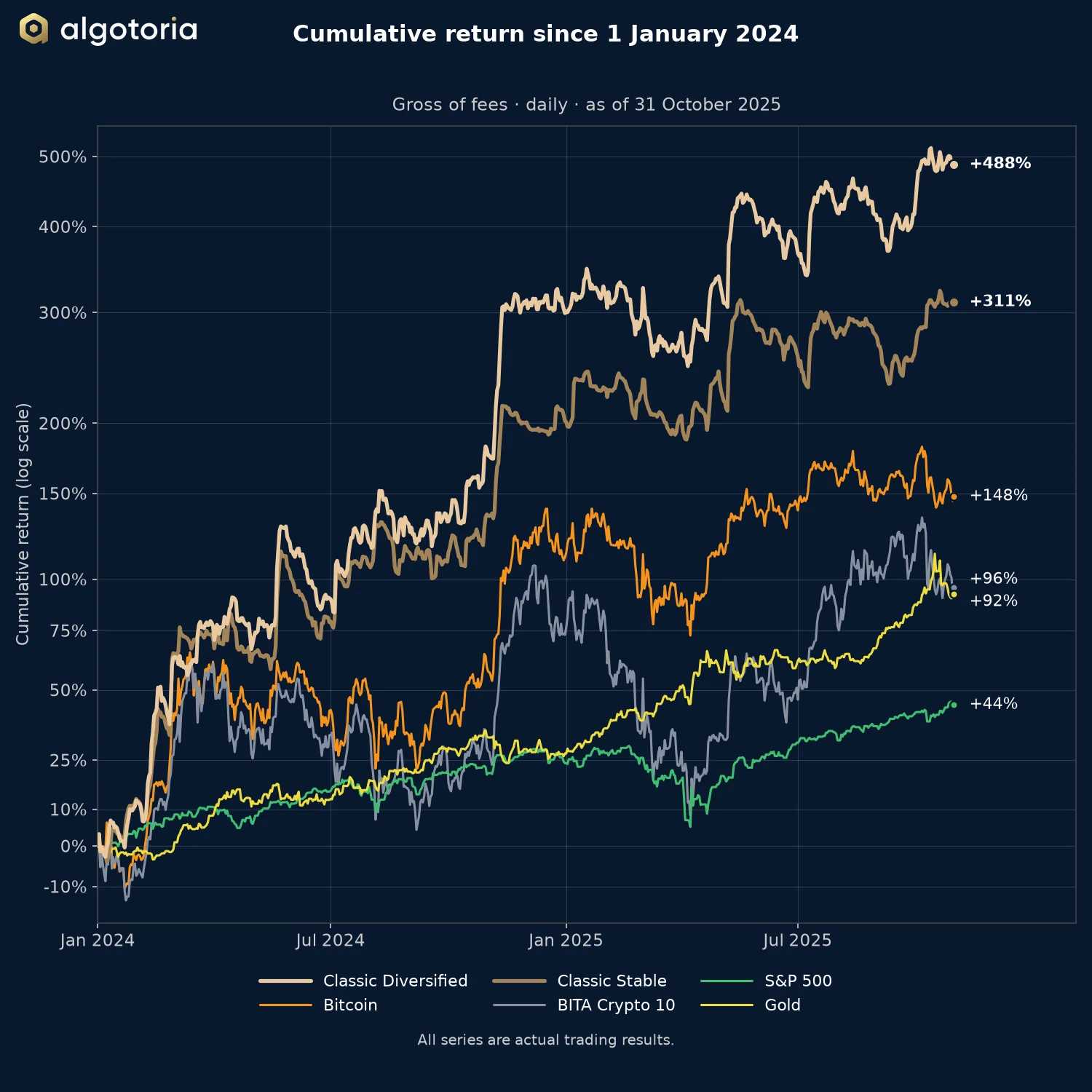
Line chart of cumulative return since 1 January 2024 for Classic Diversified and Classic Stable against Bitcoin, BITA Crypto 10, the S&P 500 and gold, as of 31 October 2025.
Cumulative return since 1 January 2024, gross of fees, as of 31 October 2025. Logarithmic scale.

October brought a record high for Bitcoin and then a sharp sell-off. Classic Stable returned +14.53% and Classic Diversified returned +13.90%, as the trend algorithms earned in both phases of the month.

Performance

October 2025 and year to date
OctoberYear to date
GrossNet 25%GrossNet 25%
Classic Diversified +13.90%+11.73%+47.26%+24.15%
Classic Stable +14.53%+14.53%+36.24%+20.53%
Longer periods
12 monthsSince 1 January 2024
GrossNet 25%Gross
Classic Diversified +109.83%+76.90%+488%
Classic Stable +73.67%+53.64%+311%
Returns to 31 October 2025.

Portfolio manager’s comment

Bitcoin reached an all-time high of about $126,200 on 6 October, after a climb of almost two weeks from about $109,000 in late September. It was a record for the largest crypto asset.

A sharp reversal followed. On 10 and 11 October the market saw the largest one-day liquidation of futures positions on record, about $20 billion. Bitcoin fell from about $122,500 to about $102,000, and the heavy use of leverage turned the fall into a chain of forced liquidations.

Altcoins, memecoins and AI tokens fell harder than Bitcoin, by 30% to 70% in many cases. About 75 of the top 100 crypto assets ended the month lower. The total market capitalisation of crypto assets declined by about 9% in October, from $4.08 trillion to $3.70 trillion.

What drove the results

The algorithms first captured the rise at the start of October, then profited from the fall. Trend-following algorithms trade in both directions, so a sharp decline is a source of return as well as a risk. Bitcoin itself returned −3.89% over the month.

The second half of October was range-bound, and the strategies gave back a small part of their gains. Classic Stable finished at +14.53% and Classic Diversified at +13.90%.

Volatility still has room

Over the three months to 31 October, Bitcoin returned −5.31%, a modest move against the swings inside the period. Volatility, realised and expected, still has room to expand.

The strategies trade long and short across liquid perpetual futures, and they trade under fixed risk controls. Wider moves in price, in either direction, are the conditions in which the algorithms work.

Get Started

Typical onboarding takes one business day, plus the international bank transfer if you fund from fiat.

Start a conversation

Tell us a little about yourself and a co-founder will reply within one business day.

By submitting, you agree we may contact you at the details above. We do not share your data with third parties. For qualified investors only. We keep enquiry details for 12 months if they do not lead to a relationship. See our Privacy Notice at algotoria.com/privacy.

How is performance measured? Why does my exchange dashboard show a different number?

Daily time-weighted returns (TWR) with compounding, computed from the unrealised margin balance of each strategy's reference portfolio, denominated in USDT and rebased to 0.00% on 1 January 2024 for the public chart. TWR is the industry-standard methodology that eliminates the distortive effect of capital movements (deposits and withdrawals) on the percentage return. Exchange dashboards (OKX, Binance, Bybit) use simplified estimation methods that do not properly handle transfers, so their headline percentage will differ. The absolute dollar-denominated P&L on the exchange dashboard remains correct; only the percentage is affected.

What is the fee structure, and how does the high-water mark work?

Zero management fee, zero entry fee. A quarterly performance fee of 25–30% (tiered by allocation size) on Net Trading Profits above a rolling high-water mark. Formula: P = E − MAX(B, HW) − I, where E is the ending balance, B is the starting balance, HW is the rolling high-water mark, and I is net inflows/outflows. If the account falls below the HWM, no fees are levied until the deficit is fully recovered through trading gains. Clawbacks are explicitly not applied. Classic Diversified and Classic Stable both use the NAV-based variant (AMA §1.1.18(a)); the Isolated USDT variant (§1.1.18(b)) applies only to Custom-Collateral accounts. Fee tiering is documented in Exhibit 1 of the Asset Management Agreement.

How can I independently verify the live track record?

Via TradeLink Passport, which streams each strategy's reference portfolio through a read-only exchange API. Links to the Classic Diversified and Classic Stable portfolios are on the Classic Diversified and Classic Stable pages. On request, Algotoria will additionally provision read-only API keys to your designated auditor or verification platform, giving direct access to the full trade history and daily return series on the underlying exchange accounts — so you can reconstruct and verify every published metric without relying on firm-generated reports.

What drawdowns should I realistically expect?

Typical annual drawdowns of 20–25% on Algotoria Classic Stable, 15–30% on Algotoria Classic Diversified. Historical back-tests reached 30%. Drawdowns beyond these ranges trigger a formal Investment Committee review.

All drawdown figures quoted on this site — and the agreed drawdown budget selected during onboarding — are measured on the gross trading-account return curve, before deduction of Algotoria's quarterly performance fee. Net-of-fee drawdowns experienced by the investor are larger by construction. Worked example: for Algotoria Classic Stable over 2024-01-01 → 2026-09-30, the adjusted maximum drawdown is −24.7% gross, −30.2% net of a 25% fee, and −31.3% net of a 30% fee.

See the full due-diligence FAQ for 50+ additional questions.
Algotoria Limited is a BVI-regulated Approved Investment Manager under the Securities and Investment Business Act, 2010. The content on this page is informational and does not constitute an offer to sell securities or investment advice. Services are available to qualified investors only. Past performance is not indicative of future results.