Market commentary

The August 2024 sell-off: Classic Stable and Classic Diversified

5 August 2024

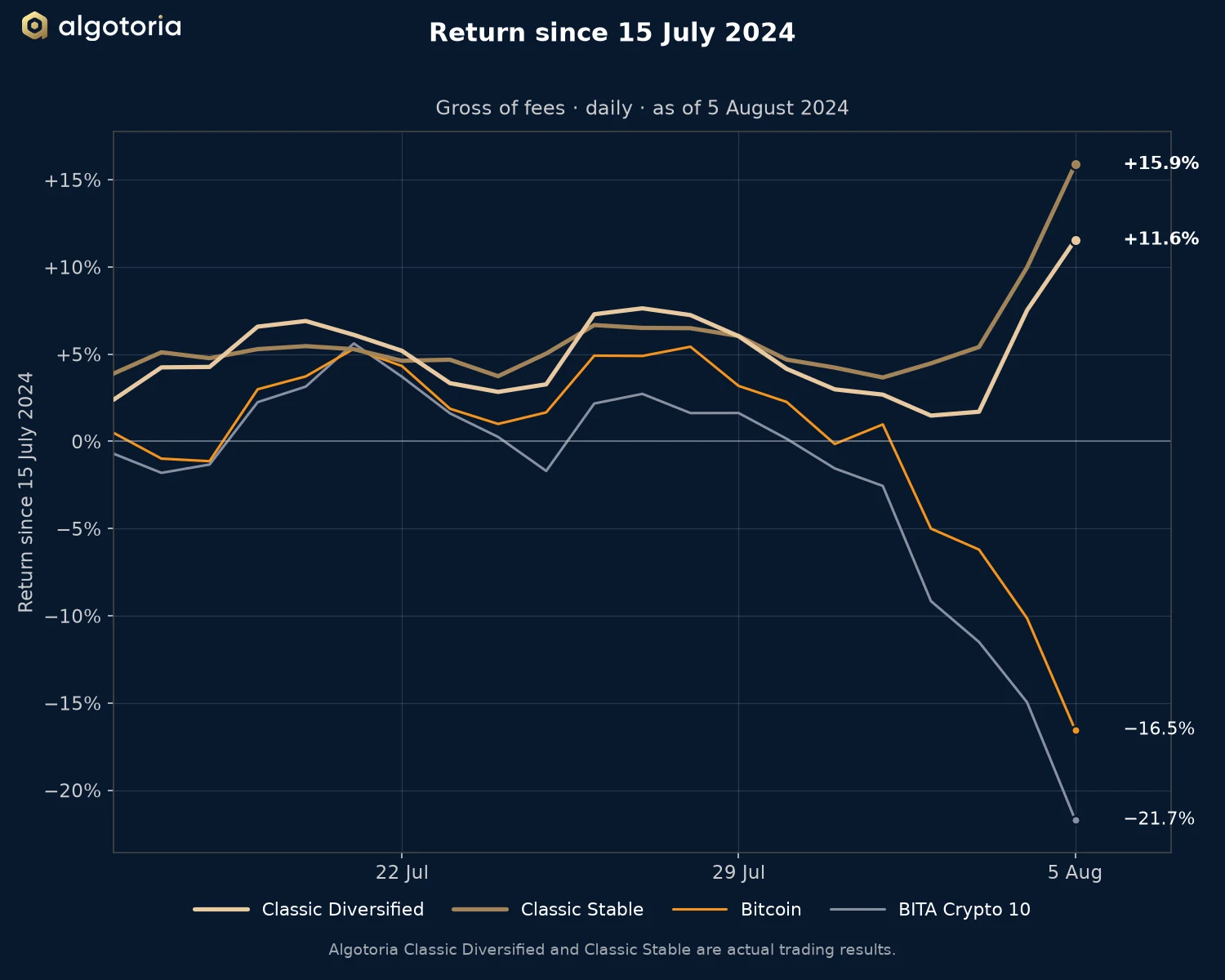
Line chart of return from 15 July to 5 August 2024 for Classic Diversified and Classic Stable against Bitcoin and BITA Crypto 10.
Return since 15 July 2024, gross of fees, daily, as of 5 August 2024.

The crypto market fell sharply over the weekend of 2 to 5 August 2024. From the close on Friday 2 August to the close on Monday 5 August, Bitcoin returned −12.15% and the BITA Crypto 10 index −13.81%.

Returns over the weekend

2 to 5 August 2024
Strategy Return over the weekend
Classic Diversified +9.92%
Classic Stable +10.92%
Bitcoin −12.15%
BITA Crypto 10 −13.81%
Close of 2 August to close of 5 August 2024 (UTC), gross of fees.

Both strategies ended the weekend higher. Classic Stable returned +10.92% and Classic Diversified +9.92%.

Why a fall in the market can help

The strategies are long-short. The algorithms open both long and short positions, so a falling market is not a headwind for them in itself. A sharp, fast move in either direction is the kind of market they are built to trade.

Classic Diversified returned slightly less than Classic Stable over the weekend. Part of its collateral is held in bitcoin, which fell with the market, while the collateral of Classic Stable is held in stablecoins.

The longer view

Since 1 January 2024, Classic Stable has returned +130% and Classic Diversified +138%, with reinvestment and before performance fees. Bitcoin returned +22% over the same period.

One weekend does not define a strategy’s record. The strategies should be judged over a period long enough to include both falling and rising markets.

Get Started

Typical onboarding takes one business day, plus the international bank transfer if you fund from fiat.

Start a conversation

Tell us a little about yourself and a co-founder will reply within one business day.

By submitting, you agree we may contact you at the details above. We do not share your data with third parties. For qualified investors only. We keep enquiry details for 12 months if they do not lead to a relationship. See our Privacy Notice at algotoria.com/privacy.

When does the strategy excel, and where does it struggle?

It thrives in trending and trending-volatile regimes — sustained moves in either direction, with enough volatility for the entry and exit logic to capture range. It struggles in extended low-volatility regimes where signals do not develop, and in chop where directional moves reverse before take-profits trigger. The counter-trend and volatility-filter sub-strategies were added specifically to dampen performance in those conditions. Concrete evidence: during January–February 2026, Bitcoin fell roughly 24% while Algotoria Classic Stable returned approximately +49% gross and Classic Diversified approximately +28% gross — directional short-side moves are favourable conditions, not catastrophic ones.

Why Algotoria, and how do I choose between Classic Diversified and Classic Stable?

Algotoria is a BVI-licensed Approved Investment Manager (Certificate IBR/AIM/25/2214) running a fully systematic long–short programme in liquid cryptocurrency perpetual futures since October 2023. Four properties set us apart from a typical crypto manager:

  • Non-custodial. Every client funds a Separately Managed Account in their own name at Binance, OKX or Bybit. Algotoria holds a trade-only API key — never custody, never withdrawal rights. An exchange failure hurts you; an Algotoria failure cannot move your assets.
  • Performance-only fees. Zero management fee, zero entry fee, no lock-in. We charge a 25–30% quarterly success fee against a rolling high-water mark — and we charge nothing until prior losses are recovered. The co-founders run roughly $2.47 M of their own capital in the same strategies under the same terms.
  • Independently verifiable. The live track record is streamed to TradeLink Passport via a read-only exchange API. Every figure on this site is reproducible from data we do not control.
  • AI-native operating model. The trading signals are rules-based and Investment Committee–approved; AI is not used in trading decisions. But every operational function — compliance, risk reporting, investor support, software development — runs through AI-assisted workflows under human-in-the-loop oversight. That keeps the cost base lean and structurally supports the 0% management fee.

Algotoria Classic, the live family, offers two strategies, both running the same algorithmic engine and the same trend-following / counter-trend mix — 66% / 34% as at 31 August 2026, reset each quarter by the Investment Committee within a 50–100% / 0–50% range according to the market regime — across 10 to 50 uncorrelated sub-strategies on BTC, ETH and liquid altcoin perpetual futures (a mandate of up to 40 instruments; 11 in the current book).

Algotoria also runs a second, next-generation family, Algotoria Spike, which is pre-production and simulated; see What is Algotoria Spike? below.

  • Algotoria Classic Diversified — collateral is BTC, approved stablecoins and RWAs, managed by Algotoria. Target gross CAGR above 120% at the 35% drawdown budget, target Calmar above 3.5, budget customisable between 15% and 35%.
  • Algotoria Classic Stable — collateral is approved stablecoins, including USDT, USDC, RLUSD, OKUSD and USDG. Target gross CAGR above 90% at the 30% drawdown budget, target Calmar above 3.0, budget customisable between 10% and 30%. For stablecoins other than USDT, the account may borrow USDT against them to open USDT-margined perpetual positions, and the borrowed USDT accrues interest at the exchange’s rate, borne by the account; yield-bearing stablecoins (RLUSD, OKUSD, USDG) typically earn more than this cost. USDT collateral carries no such cost.

The minimum allocation is the same for both ($50 k / $100 k / $150 k by risk tier). Both use the NAV-based method for the success fee (AMA §1.1.18(a)); the Isolated USDT method (§1.1.18(b)) applies only to Custom-Collateral accounts. See the side-by-side comparison on the Classic Family before you choose.

What drawdowns should I realistically expect?

Typical annual drawdowns of 20–25% on Algotoria Classic Stable, 15–30% on Algotoria Classic Diversified. Historical back-tests reached 30%. Drawdowns beyond these ranges trigger a formal Investment Committee review.

All drawdown figures quoted on this site — and the agreed drawdown budget selected during onboarding — are measured on the gross trading-account return curve, before deduction of Algotoria's quarterly performance fee. Net-of-fee drawdowns experienced by the investor are larger by construction. Worked example: for Algotoria Classic Stable over 2024-01-01 → 2026-09-30, the adjusted maximum drawdown is −24.7% gross, −30.2% net of a 25% fee, and −31.3% net of a 30% fee.

How is performance measured? Why does my exchange dashboard show a different number?

Daily time-weighted returns (TWR) with compounding, computed from the unrealised margin balance of each strategy's reference portfolio, denominated in USDT and rebased to 0.00% on 1 January 2024 for the public chart. TWR is the industry-standard methodology that eliminates the distortive effect of capital movements (deposits and withdrawals) on the percentage return. Exchange dashboards (OKX, Binance, Bybit) use simplified estimation methods that do not properly handle transfers, so their headline percentage will differ. The absolute dollar-denominated P&L on the exchange dashboard remains correct; only the percentage is affected.

See the full due-diligence FAQ for 50+ additional questions.
Algotoria Limited is a BVI-regulated Approved Investment Manager under the Securities and Investment Business Act, 2010. The content on this page is informational and does not constitute an offer to sell securities or investment advice. Services are available to qualified investors only. Past performance is not indicative of future results.