Company news

Algotoria Tide: a drawdown-first strategy family

24 November 2026

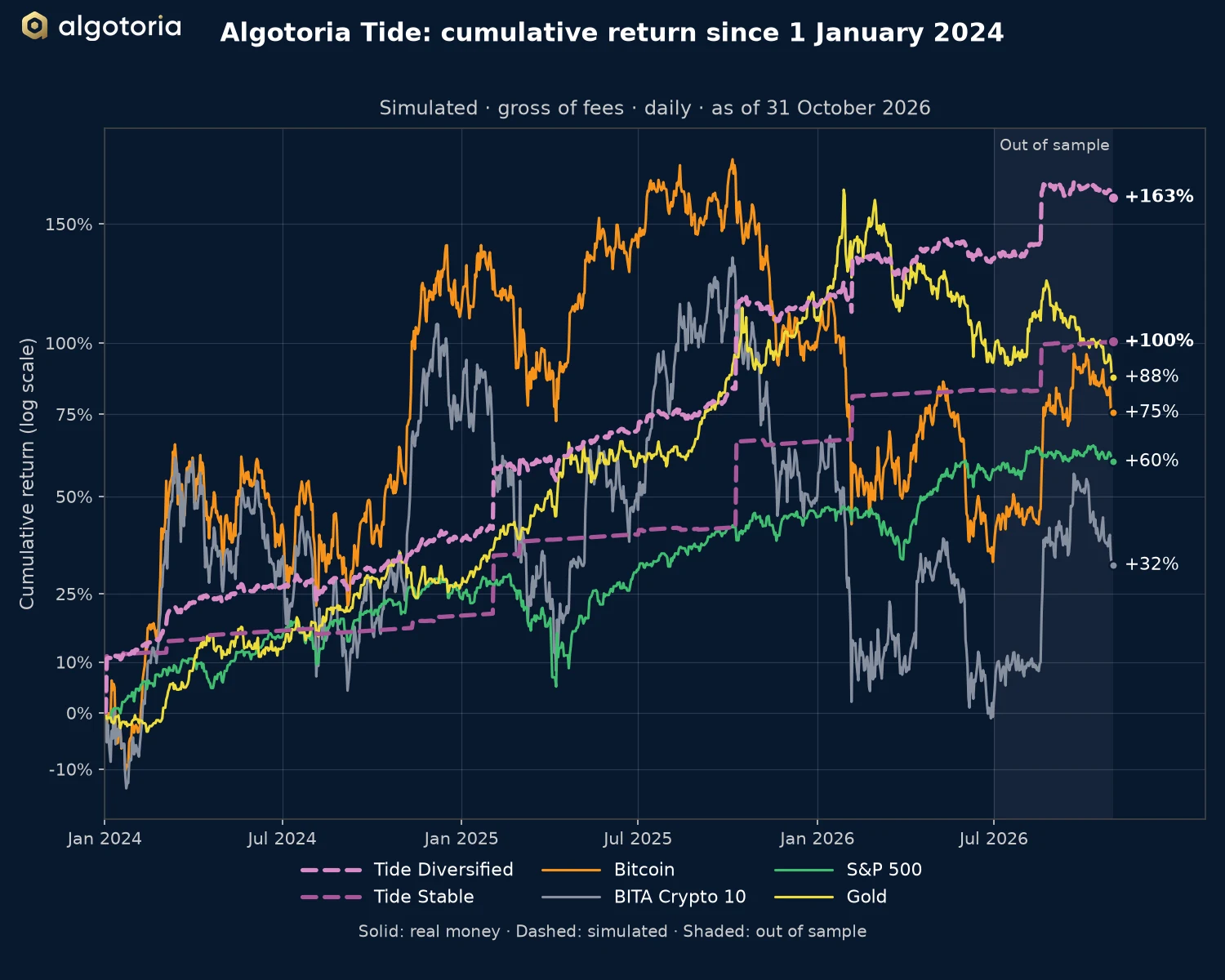
Line chart of the simulated cumulative return since 1 January 2024 of Algotoria Tide Diversified and Algotoria Tide Stable against Bitcoin, BITA Crypto 10, the S&P 500 and gold, on a log scale, with the out-of-sample period from 1 July 2026 shaded.
Simulated, gross of fees, daily, as of 31 October 2026; out of sample from 1 July 2026. The Tide family page carries the chart net of the standard performance fee as well.

Algotoria today introduces Algotoria Tide, a family of two systematic crypto strategies built around one priority: keeping drawdowns shallow. Algotoria Tide Stable and Algotoria Tide Diversified are pre-production strategies, with a target launch date of 1 January 2027. Their results are simulated, and neither has managed client money yet.

Why a new strategy family

Algotoria already runs two strategy families. Algotoria Classic is the battle-tested family: a rule-based long–short book with a real-money record through different market conditions. Algotoria Spike is a next-generation family, selective by design: it stays out of the market most of the time and deploys only on high-conviction momentum moves. Its results are simulated.

Algotoria Tide answers a different question. Many investors ask first how deep a strategy can fall and how it behaves on the days the market breaks. Tide is built around that question: its neural network forecasts the shape of each move, and Tide uses that forecast to decide how much risk to take.

How Algotoria Tide reads the market

  • The shape of the move. A neural network forecasts three things about every move: how long it is likely to last, how far it may run, and how violent the market may turn.
  • Exposure sized by conviction. Position size follows the model’s own conviction, and the book eases off ahead of the volatile days the model anticipates.
  • A crash-candle guard. When the five altcoins it trades fall sharply together within one five-minute candle, no new position opens at the next step. The guard never closes a position.
  • One signal, two collateral books. Both strategies take the same trades on the same seven perpetual futures: Bitcoin, Ethereum and five major altcoins.

How Algotoria Tide differs

  • From Algotoria Classic. Classic is a rule-based long–short book that is in the market most of the time. Tide is a neural-network strategy that stays in cash most of the time and enters only when its model expects a favourable move. It is directional and long-biased.
  • From Algotoria Spike. Both are next-generation neural-network strategies, simulated and in pre-production, but they are separate models, trained and run independently. Spike is built to capture momentum when its conviction is high. Tide is built to keep drawdowns shallow: it sizes each position by its own forecast of how violent the market may turn, and it blocks new entries right after a market-wide crash candle.

Two collateral books

Algotoria Tide waits for its opportunities. On the simulated record from 1 January 2024 to 31 October 2026, it held a position about 1.5% of the time, on about 19 days a year. The rest of the time the account holds only its collateral, and the collateral keeps working: it earns its own return while the strategy waits, and when a trade opens it serves as the margin for the perpetual futures.

Algotoria Tide Stable holds its collateral in yield-bearing US-dollar stablecoins only, RLUSD and USDG in equal halves, so the account carries no gold, equity or bitcoin price swings between trades. While Tide waits, the collateral earns the stablecoins’ yield.

Algotoria Tide Diversified holds half of its collateral in the same stablecoins and half outside US-dollar-backed assets, in tokenised gold, US equities and bitcoin. That half is weighted by inverse volatility within fixed limits and held at all times. While Tide waits, the collateral earns the stablecoin yield on one half and carries the gold, equity and bitcoin price moves of the other, up or down.

How the three families move together

The table shows the correlation of monthly returns between the Stable strategy of each family. A value near one means that two strategies rise and fall in the same months; a value near zero means that their monthly results are unrelated.

Correlation of monthly gross returns, Stable strategies
Tide StableSpike StableClassic Stable
Tide Stable1.000.630.19
Spike Stable0.631.000.25
Classic Stable0.190.251.00
Pearson correlation of calendar-month gross returns over the 34 months from January 2024 that all three cover. Tide Stable and Spike Stable are simulated; Classic Stable is actual trading.

Tide Stable’s monthly returns have moved largely independently of Classic Stable’s (0.19). With Spike Stable the correlation is higher (0.63): the two next-generation strategies tend to trade the same few large market days and move apart on most others. Correlation is measured on past data, most of it simulated, and is not a forecast.

A simulated record, published in full

The simulated record runs from 1 January 2024 for a constant $10 M book on OKX. Each order is worked on the historical one-second order book from 30 seconds after its signal, with exchange fees and the yield on idle collateral included.

The period from 1 July 2026 is out of sample: the models, rules and parameters were fixed before that date, and nothing was chosen on the months that followed. The Tide family page publishes the full record and its drawdowns.

Capacity

Algotoria Tide’s capacity is about $30 M, shared by Tide Stable and Tide Diversified: about $10 M on OKX, $15 M on Binance and $5 M on Bybit. The Binance and Bybit figures are estimates, scaled from each exchange’s order-book depth. The simulated record itself is priced for a constant $10 M book on OKX.

“Investors ask two questions about a strategy before they ask about its return: how deep can it fall, and what does it do on the day the market breaks. Algotoria Tide is built around those two questions. We publish its simulated record in full, priced on one-second order books with every order 30 seconds late and fees included, so that it can be judged on the evidence,” said Dr Nik Ptitsyn, Co-Founder, Chairman and Chief Product Officer of Algotoria.

What the simulation does not show

A simulation is not a track record. It cannot capture every trading cost or market regime, and a future drawdown can be deeper than any in the simulated record. Algotoria Tide remains in pre-production until its launch. Read the Risk Notice before allocating to any Algotoria strategy.

About Algotoria

Algotoria Limited is a systematic crypto asset manager incorporated in the British Virgin Islands and recognised as an Approved Investment Manager by the Financial Services Commission of the British Virgin Islands under the Securities and Investment Business Act, 2010. It works with professional and institutional investors only. See all Algotoria strategies.

Get Started

Typical onboarding takes one business day, plus the international bank transfer if you fund from fiat.

Start a conversation

Tell us a little about yourself and a co-founder will reply within one business day.

By submitting, you agree we may contact you at the details above. We do not share your data with third parties. For professional investors only. We keep enquiry details for 12 months if they do not lead to a relationship. See our Privacy Notice at algotoria.com/privacy.

Why Algotoria, and how do I choose between Classic Diversified and Classic Stable?

Algotoria is a BVI-licensed Approved Investment Manager (Certificate IBR/AIM/25/2214). We trade perpetual futures on cryptocurrencies and real-world assets (RWAs). Algotoria Classic has traded liquid cryptocurrency perpetual futures since October 2023. Our approach has four defining features.

  • Non-custodial. Every client funds a Separately Managed Account in their own name at Binance, OKX or Bybit. Algotoria holds a trade-only API key — never custody, never withdrawal rights. An exchange failure hurts you; an Algotoria failure cannot move your assets.
  • Performance-only fees. Zero management fee, zero entry fee, no lock-in. We charge a 25–30% quarterly success fee against a rolling high-water mark — and we charge nothing until prior losses are recovered. The co-founders run roughly $2.47 M of their own capital in the same strategies under the same terms.
  • Independently verifiable. The live track record is streamed to TradeLink Passport via a read-only exchange API. Every figure on this site is reproducible from data we do not control.
  • AI-native operating model. The trading signals are rules-based and Investment Committee–approved; AI is not used in trading decisions. But every operational function — compliance, risk reporting, investor support, software development — runs through AI-assisted workflows under human-in-the-loop oversight. That keeps the cost base lean and structurally supports the 0% management fee.

Algotoria Classic, the live family, offers two strategies, both running the same algorithmic engine and the same trend-following / counter-trend mix — 66% / 34% as at 31 August 2026, reset each quarter by the Investment Committee within a 50–100% / 0–50% range according to the market regime — across 10 to 50 uncorrelated sub-strategies on BTC, ETH and liquid altcoin perpetual futures (a mandate of up to 40 instruments; 11 in the current book).

Algotoria also runs a second, next-generation family, Algotoria Spike, which is pre-production and simulated; see What is Algotoria Spike? below.

  • Algotoria Classic Diversified — collateral is BTC, approved stablecoins and RWAs, managed by Algotoria. Target gross CAGR above 120% at the 35% drawdown budget, target Calmar above 3.5, budget customisable between 15% and 35%.
  • Algotoria Classic Stable — collateral is approved stablecoins, including USDT, USDC, RLUSD and USDG. Target gross CAGR above 90% at the 30% drawdown budget, target Calmar above 3.0, budget customisable between 10% and 30%. For stablecoins other than USDT, the account may borrow USDT against them to open USDT-margined perpetual positions, and the borrowed USDT accrues interest at the exchange’s rate, borne by the account; yield-bearing stablecoins (RLUSD, USDG) typically earn more than this cost. USDT collateral carries no such cost.

The minimum allocation is the same for both ($50 k / $100 k / $150 k by risk tier). Both use the NAV-based method for the success fee (AMA §1.1.18(a)); the Isolated USDT method (§1.1.18(b)) applies only to Custom-Collateral accounts. See the side-by-side comparison on the Classic Family before you choose.

What drawdowns should I realistically expect?

Typical annual drawdowns of 20–25% on Algotoria Classic Stable, 15–30% on Algotoria Classic Diversified. Historical back-tests reached 30%. Drawdowns beyond these ranges trigger a formal Investment Committee review.

All drawdown figures quoted on this site — and the agreed drawdown budget selected during onboarding — are measured on the gross trading-account return curve, before deduction of Algotoria's quarterly performance fee. Net-of-fee drawdowns experienced by the investor are larger by construction. Worked example: for Algotoria Classic Stable over 2024-01-01 → 2026-10-31, the adjusted maximum drawdown is −24.7% gross, −30.2% net of a 25% fee, and −31.3% net of a 30% fee.

What reports do I receive once I am invested?

A monthly investor report covering: rolling Calmar ratio, drawdown profile, exposure composition, strategy-level attribution, realised correlations, fees accrued, and net-of-fee return. Quarterly performance-fee statements accompany billing. The Algotoria Telegram bot (@AlgotoriaBot) is the firm's client-facing monitoring interface — on-demand account overview, PnL charts over 24h / 7d / 30d / 90d / 1y / all-time, quarterly reports showing PnL / HWM / fee calculations, multi-account switching for clients with more than one SMA, configurable daily / weekly / monthly notifications, and shareable read-only links for a compliance officer or co-investor. Access is granted per account by your relationship manager. The bot is read-only; it does not execute trades.

What is the difference between an SMA and an MSA? Which should I open?

In a Separately Managed Account (SMA) the client is the master account holder at the exchange and retains full control of API keys; Algotoria is whitelisted with a trade-only key. In a Managed Sub-Account (MSA) Algotoria provisions a dedicated sub-account under its institutional umbrella — the client still owns the assets, but the sub-account usually qualifies for preferential VIP trading fees. For most clients an MSA is the better economics; SMA is the right choice when the client requires direct treasury control over the master account or already holds a VIP tier of their own.

Why are the Algotoria Spike results simulated, and what does that mean?

Neither Algotoria Spike strategy has managed client money yet. Their records are replays of the Algotoria Spike signal, generated walk-forward, through the production trading engine on exchange candles, so they show how the design would have behaved, not what an investor earned.

A simulation is not a track record: future results will differ, often materially, and all capital committed can be lost. The collateral rule of Algotoria Spike Diversified was chosen on data within the simulation window, so its figures are a hypothesis. Only Algotoria Classic has a real-money track record. Read the Risk Disclosure Notice before allocating.

Simulated execution for a constant $10 M book on OKX: every order sized and capped as if the book were $10 M, filled on the historical 1-second order book under the production execution loop, taker fees included; returns compounded.

See the full due-diligence FAQ for 50+ additional questions.
Algotoria Limited is a BVI-regulated Approved Investment Manager under the Securities and Investment Business Act, 2010. The content on this page is informational and does not constitute an offer to sell securities or investment advice. Services are available to professional investors only. Past performance is not indicative of future results.